
Events
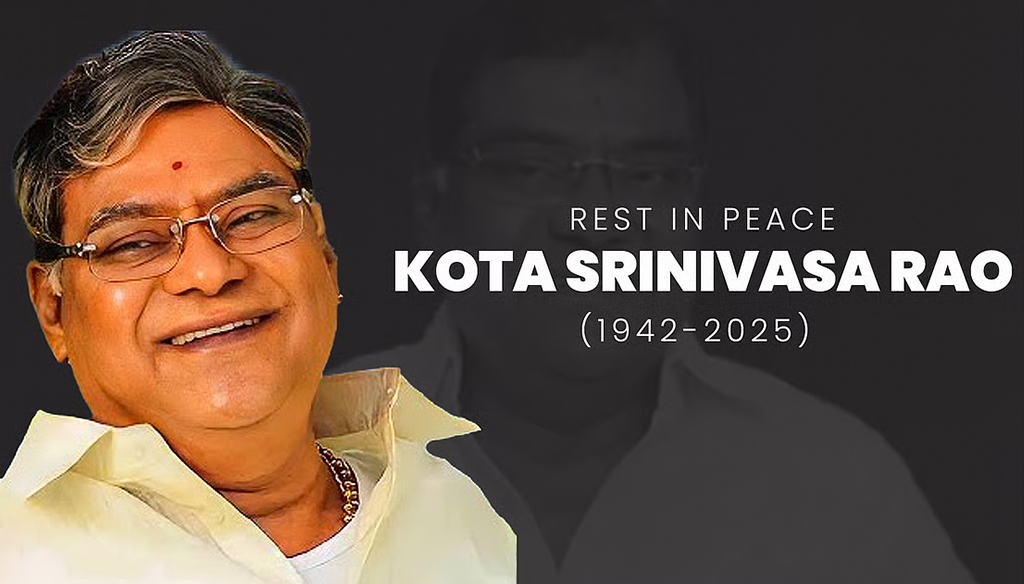
The Life and Times of Kota Srinivasa Rao: A Pillar of Indian Cinema Bids Farewell

On July 13, 2025, Indian cinema lost one of its most enduring lights—Kota Srinivasa Rao, a name that has been woven into the very fabric of Telugu cinema and Indian film history for nearly five decades. He was 77.
To speak of Kota garu is to speak of a man who embodied the soul of acting, not merely performance, but lived truth on screen. As a journalist who has spent years documenting the landscape of Indian entertainment, and more importantly, as a lifelong admirer of its emotional and artistic depth, I find it nearly impossible to separate the arc of my love for Telugu cinema from the face, voice, and commanding presence of Kota Srinivasa Rao.
Born on July 10, 1948, in Kankipadu, Andhra Pradesh, Kota Srinivasa Rao was the son of freedom fighter and dramatist Kota Seetha Rama Anjaneyulu. The stage called to him early, long before the silver screen embraced him. His transition from theater to cinema in the late 1970s was seamless, natural, and even. His debut in K. Viswanath’s Pranam Khareedu (1978) may have seemed modest at the time, but in hindsight, it was the quiet ignition of a force that would later dominate the craft of acting across genres and generations.
Kota Garu was never a man of one shade. He could play a corrupt politician one moment and a hapless, loving father the next—with equal gravitas and complete immersion. Who could forget his roles in Gaayam, Shiva, Aha Naa Pellanta, Pratighatana, Money, Anaganaga Oka Roju, Leader, and Tagore? These weren’t just performances; they were living case studies in human contradiction and nuance.
In Aa Naluguru, his portrayal of a morally grey newspaper editor offered a sobering mirror to society. In comedies like Hello Brother, his deadpan wit was so precise that it could make audiences erupt with laughter on a single line delivery. Every filmmaker—from K. Viswanath to Ram Gopal Varma, Krishna Vamsi to Sekhar Kammula—sought him out, not just for his craft, but for his wisdom. Watching him act was never passive; it was an education.
Kota Srinivasa Rao did not rely on grand gestures. He mastered silence, pauses, and subtle shifts of the eye or lip. His voice—a deep, gravelly cadence seasoned with satire and command—could either be a thunderclap or a whisper that echoed.
To those of us in the audience, especially those who grew up in Andhra Pradesh and Telangana, his voice became part of our lives. We knew it like we knew the changing winds before the monsoon. Even when he wasn’t on screen, you could feel his influence in the rhythm of dialogue and the texture of storytelling.
Despite his towering fame, Kota garu remained rooted. His brief but meaningful stint in politics—elected as MLA from Vijayawada East in 1999—reflected his desire to contribute beyond the screen. But he soon returned to his first love: the cinema.
His accolades are many, including the Padma Shri (2015) and multiple Nandi Awards, but what truly set him apart was how loved and respected he was by peers and audiences alike. For young actors and directors, working with Kota garu was a rite of passage.
Jr NTR once said in an interview, “You don’t act with Kota garu. You surrender. And in doing so, you become better without even realizing it.”
As the film industry and fans across India mourn his passing, one thing becomes clear: Kota Srinivasa Rao was not just part of Indian cinema—he was one of its pillars. He leaves behind a legacy that transcends language and time. He proved, over and over again, that you don’t need to be the lead to lead a scene. That character is not just something you play—it’s something you embody.
For those of us who grew up seeing him on VHS tapes, in dusty cinema halls, on cable TV reruns, and later streaming platforms, Kota garu’s presence was a constant. He was a reminder of what cinema was, and what it could be—pure, affecting, transformative.
As I write this not just as a journalist, but as someone whose very identity has been shaped by Indian films, I say: thank you, Kota garu. For the laughter. For the fear. For the wisdom. For the truth. Your performances were never just “roles.” They were lessons in being human.
In Gaayam, you once delivered the haunting line:
“Nijam cheppadam easy kaadu… adhi cheppataniki guts kavali.”
(“Telling the truth is not easy… It takes courage to speak it.”)
You spoke the truth through every role, and we heard you—loud and clear.
Your absence leaves a void, but your art remains. And in that, you are eternal.
Rest in peace, Kota Srinivasa Rao garu. Your voice may have fallen silent, but your cinema will echo forever.





Telugu Cinema Goes Direct to U.S. Fans: Nani and Anirudh Ravichander Bring The Paradise to Dallas

Opinion | Ramayana Changes the Game for Bollywood

Marvel Showcase

300 Part 1 vs 300: Rise of an Empire

Telugu Cinema Has Conquered Hyderabad. Is America Next?

D23 2026 Day One Delivers a Mountain of Disney Reveals, From Avengers: Doomsday and Star Wars: Starfighter to Frozen 3

The Edinburgh Fringe Gets Heated!

PAW Patrol: The Dino Movie Review: A Prehistoric Adventure That Feels Like Thunderbirds for a New Generation
Welcome home, Vision.

Are you a Jedi… or not?

Reassemble the team & relive the experience as Avengers Endgame: Encore

Ambition can’t be tamed…

Watch the first teaser trailer for The Bluey Movie, coming exclusively to theatres August 6, 2027!
Welcome home, Vision.
Are you a Jedi… or not?